When we think about planning for the future, we often think about where we want to live, how much home we need and what our lifestyle might look like.
But there’s another question that deserves a place in that conversation:
What happens if we eventually need long-term care?
It’s not always an easy question to ask. But understanding the potential costs before you need care can make an enormous difference. It gives you and your family time to consider your preferences, understand your options and think about how care might be funded.
The latest CareScout Cost of Care Survey, released in 2026 based on 2025 data, shows that long-term care remains expensive, even though the rate of cost increases moderated across most types of care.
And the numbers are worth understanding.
What Does Long-Term Care Cost?
The 2025 CareScout Cost of Care Survey shows how significantly long-term-care costs can vary in California depending on the type of care needed.
In-home care with a non-medical caregiver: about $91,520 per year
Assisted living / residential care: about $82,800 per year
Adult day health care: about $24,440 per year
Nursing home, semi-private room: about $146,000 per year
Nursing home, private room: about $182,135 per year
While costs did not rise at the same pace in every setting, long-term care remains a significant financial consideration for many California families. The CareScout survey reported a 5% year-over-year increase for non-medical home care, a 4% increase for semi-private nursing-home rooms, no change for private nursing-home rooms, and a 6% decrease in the statewide assisted-living figure. Adult day health care was reported without a comparable year-over-year change.
California annual median costs vs National
The 2025 survey found that costs vary dramatically depending on the type and level of care.
Here are the national median costs reported for 2025:
- Adult day health care: $95 per day, or about $24,700 per year based on five days a week
- Non-medical in-home care: $35 per hour, or about $80,080 per year assuming 44 hours of care per week
- Assisted living: $6,200 per month, or $74,400 per year
- Nursing home, semi-private room: $315 per day, or $114,975 per year
- Nursing home, private room: $355 per day, or $129,575 per year
- Private-duty nursing at home: $90 per hour, with a median per-visit rate of $160
The private-duty nursing figure is particularly important to understand because the annual cost depends heavily on how many hours or visits are needed.
2025 National Median Costs at a Glance
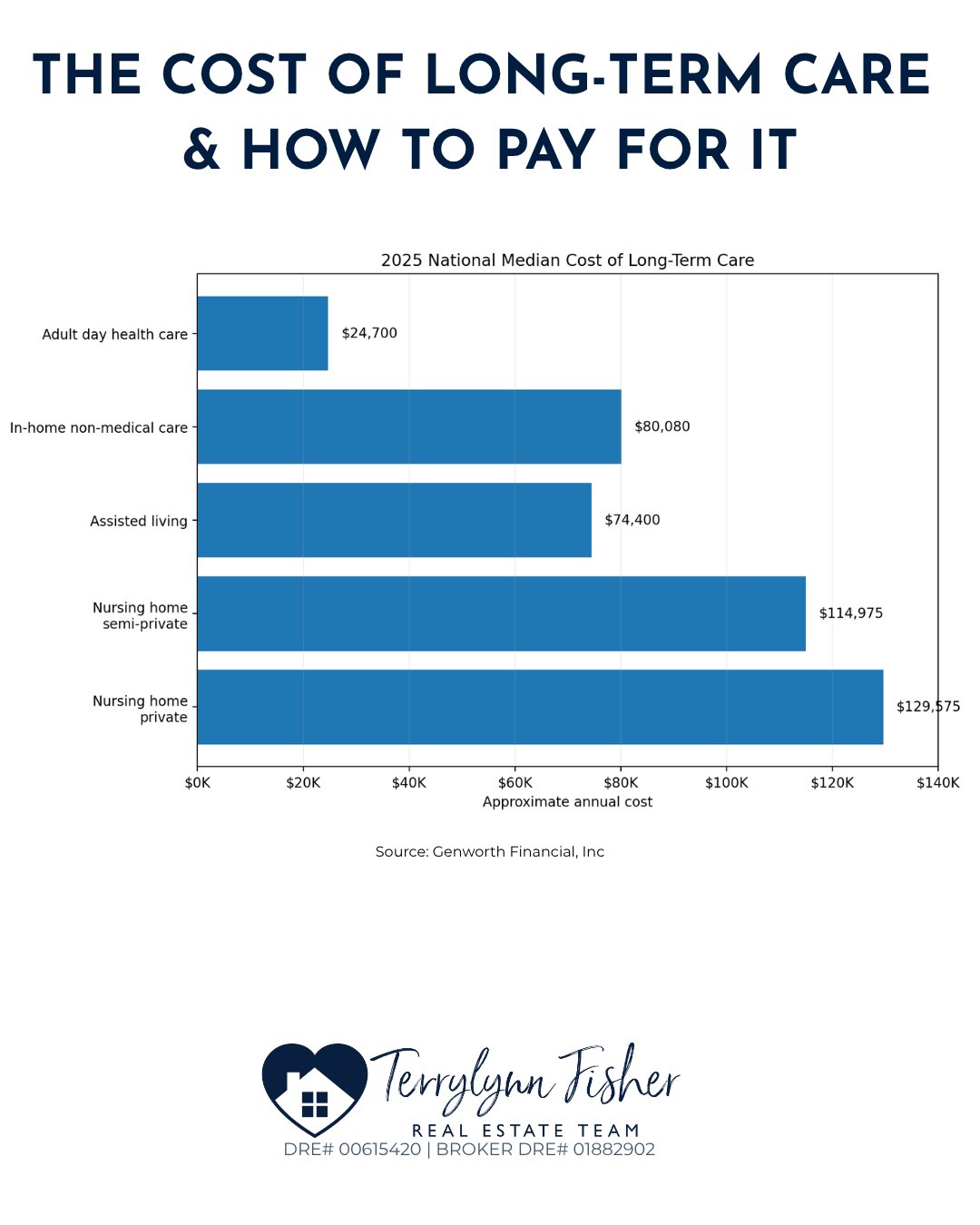
The chart makes one thing very clear: the type of care you need can have a significant impact on the cost.
And these are national median figures. Actual costs can vary considerably depending on where you live, the provider, availability and the amount and type of care required.
Costs Have Continued to Rise
The good news in the latest survey is that the pace of increases has moderated.
Most care settings experienced annual increases between 1% and 5% in 2025. Assisted living increased 5%, while in-home non-medical care increased 3%. Nursing home costs increased 2% for a semi-private room and 1% for a private room.
Adult day health care was an exception, with the national median daily rate declining 5%.
But "slower increases" doesn't mean that care has become inexpensive.
The baseline costs remain substantial.
How Do Today's Costs Compare With a Few Years Ago?
Based on the 2023 Genworth Cost of Care Survey projected significant increases in long-term care costs over the following decade.
Looking at the 2023 figures alongside the 2025 survey provides some perspective.
2023 vs. 2025
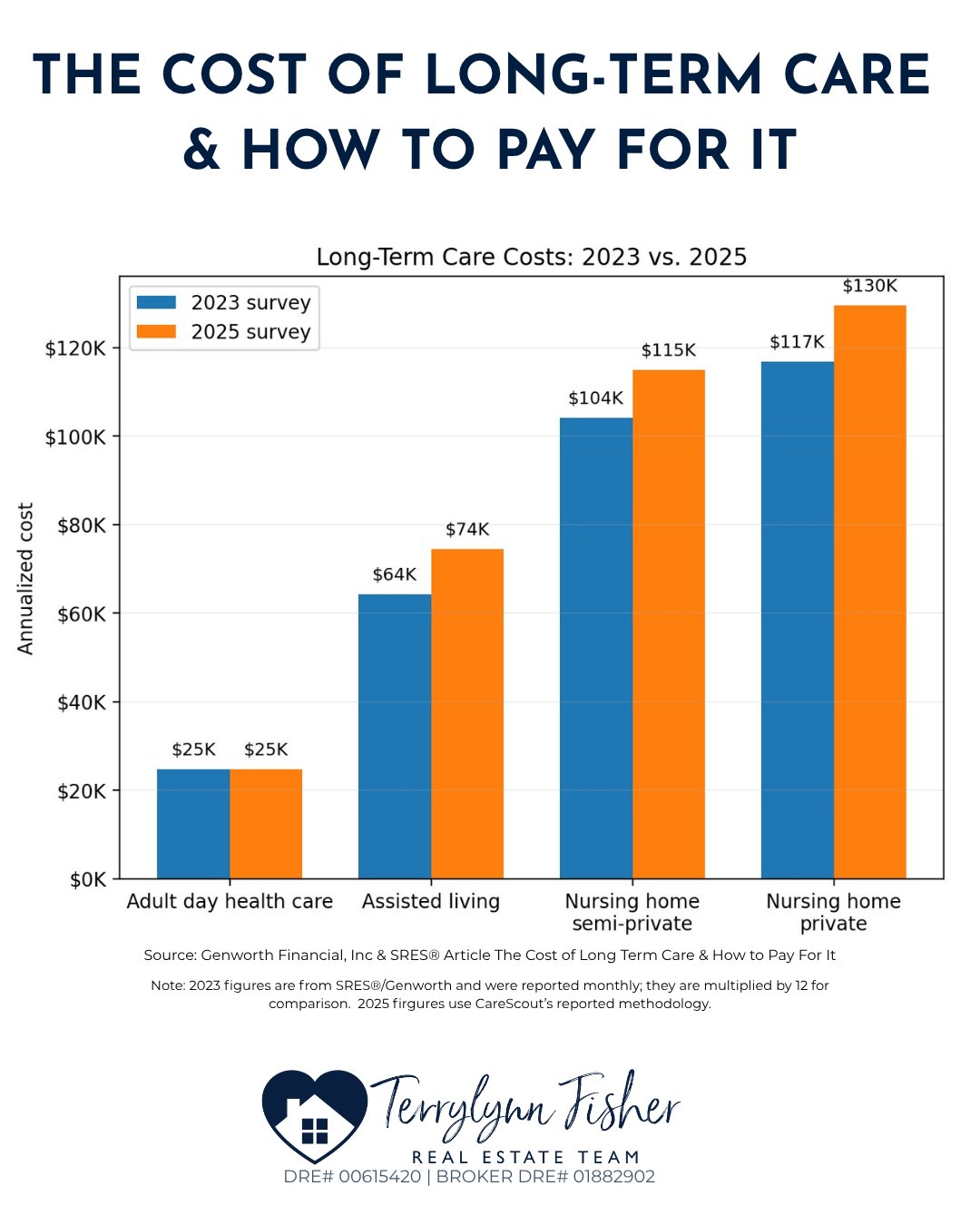
For this comparison, the 2023 monthly figures were annualized from SRES® piece so they could be viewed alongside the 2025 annual figures. This is a directional comparison, not a forecast, because the newer CareScout survey uses its current methodology and some care categories are reported differently.
Still, the overall takeaway is important: planning for potential care expenses deserves attention well before care is actually needed.
Where Does the Money Come From?
This is where the conversation becomes particularly important.
There isn't necessarily one answer for every family.
There are several potential sources for long-term care expenses, including personal savings and investments, long-term care insurance, Medicaid and Veterans benefits, immediate annuities and, in some circumstances, a reverse mortgage.
And for many homeowners, there is another significant asset to consider:
The home itself.
For some people, selling a longtime home and using the proceeds toward future care may become part of their financial plan—particularly if they're considering moving to a care community or another home that better fits their changing needs.
That doesn't mean selling your home is the answer. It simply means that your real estate can be an important piece of the larger financial conversation.
Planning Gives You More Choices
One of the most difficult situations is having to make a major housing decision quickly because circumstances have changed.
When you're planning ahead, you have time to ask questions:
Where would I prefer to live if I need more support?
Would I rather remain at home with in-home care?
Would a smaller, easier-to-maintain home make sense?
Should I explore independent living or assisted living communities?
What resources and financial options are available to me?
Those conversations can be much easier when you're having them on your own timeline rather than in the middle of a crisis.
This Is Where an SRES® Can Be a Resource
As a Seniors Real Estate Specialist® (SRES®), I understand that real estate decisions later in life often involve much more than buying or selling a property.
Sometimes my role is simply to help you understand your options.
Maybe you're wondering whether it makes sense to stay in your home and make modifications. Maybe you're thinking about downsizing. Maybe you're beginning to research different senior housing options.
And sometimes, the most helpful thing I can do is connect you with other trusted professionals who can help with the financial, legal or care-related pieces of the puzzle.
You don't have to have all the answers before you start asking the questions.
Long-term care planning isn't about assuming something will happen. It's about giving yourself and your family more information and more choices if it does.
And when your home is one of your most valuable assets, understanding how it fits into that bigger picture can be an important part of the conversation.
If you've been thinking about what the next chapter might look like, I'm always happy to sit down and talk through your real estate options—without pressure and without assuming you need to make a move today.
Planning ahead isn't about predicting the future. It's about being better prepared for it.
REALTOR® and RESOURCE are synonymous. It’s your real estate journey… I am the guide.
Your REALTOR® for life,
Terrylynn Fisher
Source: CareScout, 2025 Cost of Care Survey, California statewide data. Survey period: July–November 2025. CareScout, 2025 CareScout Cost of Care Survey, National data
Important accuracy notes
The original figures—$80,080 for in-home care, $74,400 for assisted living, $24,700 for adult day care, $114,975 for a semi-private nursing-home room, and $129,575 for a private room—are the 2025 national medians.
CareScout calculates annual in-home non-medical caregiver cost using 44 hours per week for 52 weeks. Actual costs can be substantially higher or lower depending on care hours, location, agency rates, and the person’s needs.
In California, CareScout refers to assisted living as a Residential Care Facility in its state-specific survey materials.
These are statewide survey figures. Contra Costa County and Bay Area costs may differ from the California median, so avoid describing the statewide figure as a guaranteed local price.